In The Beginning there was Red
The earliest recorded art work in south Sulawesi, Indonesia is dated at around 38,000 years old found on a cave wall was made from only red and white pigment and hand stencils. The reason is that this parietal artwork was created from these two colours is because around 40,000 years ago the two only accessible pigments with a basic means of refining were white and red. A large proportion of the earth’s crust is made up of a ferrous rock called hematite (iron ore) or goethite. These metamorphic rocks can be simply crushed and mixed with water or other solvents to form a red pigmented paste which is what has been used in these early cave paintings. these two pigments were the most widely used for another 10-15,000 years when charcoal, yellows and blues were developed in early civilisations. Although its speculated these cave paintings weren’t simply for decoration it spurred the development of recreational artful the next 40,000.
Some of the most iconic reds in history was the Carmine red used by the Romans to die their army’s clothes, plumes and paint their shields. This was made from the blood of crushed up Kermes Beetles as only the most fervent red was used for religious scenes and rich aristocracy. Red remained a valuable resource and in the 1600’s Spain controlled the trade with Cochineal Beetles from the Americas, being the centre of Europe’s Red fabrics, cosmetics and paint. It remained a crucial pigment and has had a variety of sources often unstable or unsustainable but consistently a major part of Western culture up to present day

I want to look at how the most vibrant and visceral pigment; red, has been used over those years, how it has changed, developed to its uses in present day artists. in particular I will look at its most pronounced and vivid use in the interpretation of the conglomeration of flesh bone and sinew.
The Encapsulation of Flesh in Form
Chaïm Soutine
Chaïm Soutine was a Russian born artist who was a pioneer of the impressionist movement and was prolific through conjoining abstract expressionism with more traditional styles in Paris in the early to mid-19th century. Soutine was awry with complex emotions and depression he documented through his life but is seen in his works, through subject matter and the way he painted, poured onto the canvas. His later more developed body of work goes beyond the avant garde movement of the time. his unique perspective for tackling such an abstract subject matter made his works so interesting even to this present day very few artists have been able to recreate something a delicate yet intriguing as he did, his mind seemed to work differently to most. “once i the village butcher slice the neck of a bird n drain the blood out of it. i wanted to cry out but his joyful expression caught the sound in my throat… this cry, i always feel it there. when, as i drew a crude portrait of my professor i tried to rid myself of this cry, but in vain. when i painted the beef carcass it was still this cry that i wanted to liberate. i have still not succeeded” – Soutine.
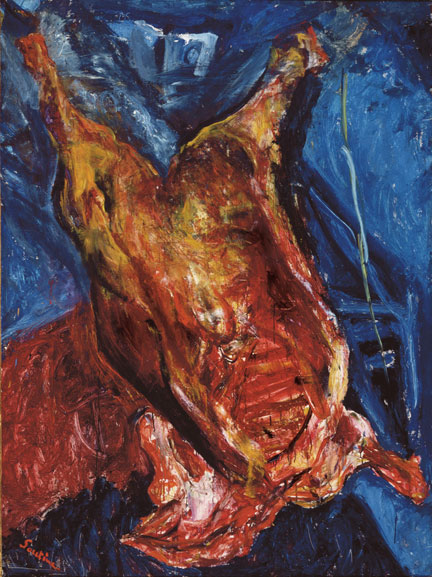
Arguably his most famous piece of work, carcass of beef was also one of his earliest. it was a direct quote to Rembrandts’ slaughtered ox which he repeatedly visited and studied in the louvre. the choice of a carcass was also spurred on by his love and interest of food present in almost all of his still life’s, which he would try best to preserve their freshness as he was painting. When painting carcass of beef which he hung in his Paris apartment for several days he would pour a fresh bucket of cow’s blood over the carcass to keep the vibrant colours of freshly cut meat. this adds new and even more unique dynamic to his painting as he is layering the oils onto his canvas at the same time he is layer blood and his desired beauty onto the carcass. this conjoined layering makes the painting process seem even more authentic as he would have been right in front of the decaying dripping stinking carcass immersed in the aura of it all whilst painting it with a sort of frantic turmoil or haste but precision and passion.

Similarly, to his carcass of beef in another of his 10 paintings orientated on cow carcasses was a side of beef with veal head. although this picture lacks the scale of the entire carcass it has a slightly different set of reds that are far brighter and almost more artificial looking compared to carcass of beef, this might be as it was painted before carcass of beef in 1923 when he was less experienced with the subject matter and didn’t pour fresh blood over the flesh regularly. However, in a way it has almost captured the dryness of the meat as it doesn’t look clean and fresh. The integral part of this painting for me is that the veal head is hanging on the butchers hook next to a cut of beef that isn’t its own. Soutine has purposely ordered a different cut from his butchers. This is suggested to have been down to his childhood and represents a struggle of disembodiment and isolation, perhaps from his mother or himself due to his complex depression. Despite the head not being flayed Soutine uses a fleshy pink and red to depict much of the veal head. causing the head to catch the viewers eye as anomaly to the vibrant red cut of flesh.

One of Soutine’s later pieces la femme en rouge is a darker piece looking at the distinction between flesh, skin and clothes. His interpretation of a woman sitting in chair wearing a red dress is manipulated and twisted, it’s very reminiscent of Edvard Munch’s’ the scream with a slightly haunted aspect the eerie visceral scarlet and red tones are almost identical to the colour and composition of carcass of beef. the manipulation of the dress it lends the aspect of a sort of spinning motion and makes the viewer very inquisitive of the painting. Of course, the most striking aspect of the painting is the deep crimson, sanguine red that the flowing dress is, in an instance one is reminded of Soutine’s beef studies.
The Anonymity of Meat
Victoria Reynolds
Victoria Reynolds shows a new level of development with an eerie complexity to what they actually are. The Flesh is prevalent but they are very clean flowing natural images of photo like quality encased in elaborate rococo frames adding a sense of majesty to a subject that is really quite disturbing at its essence.
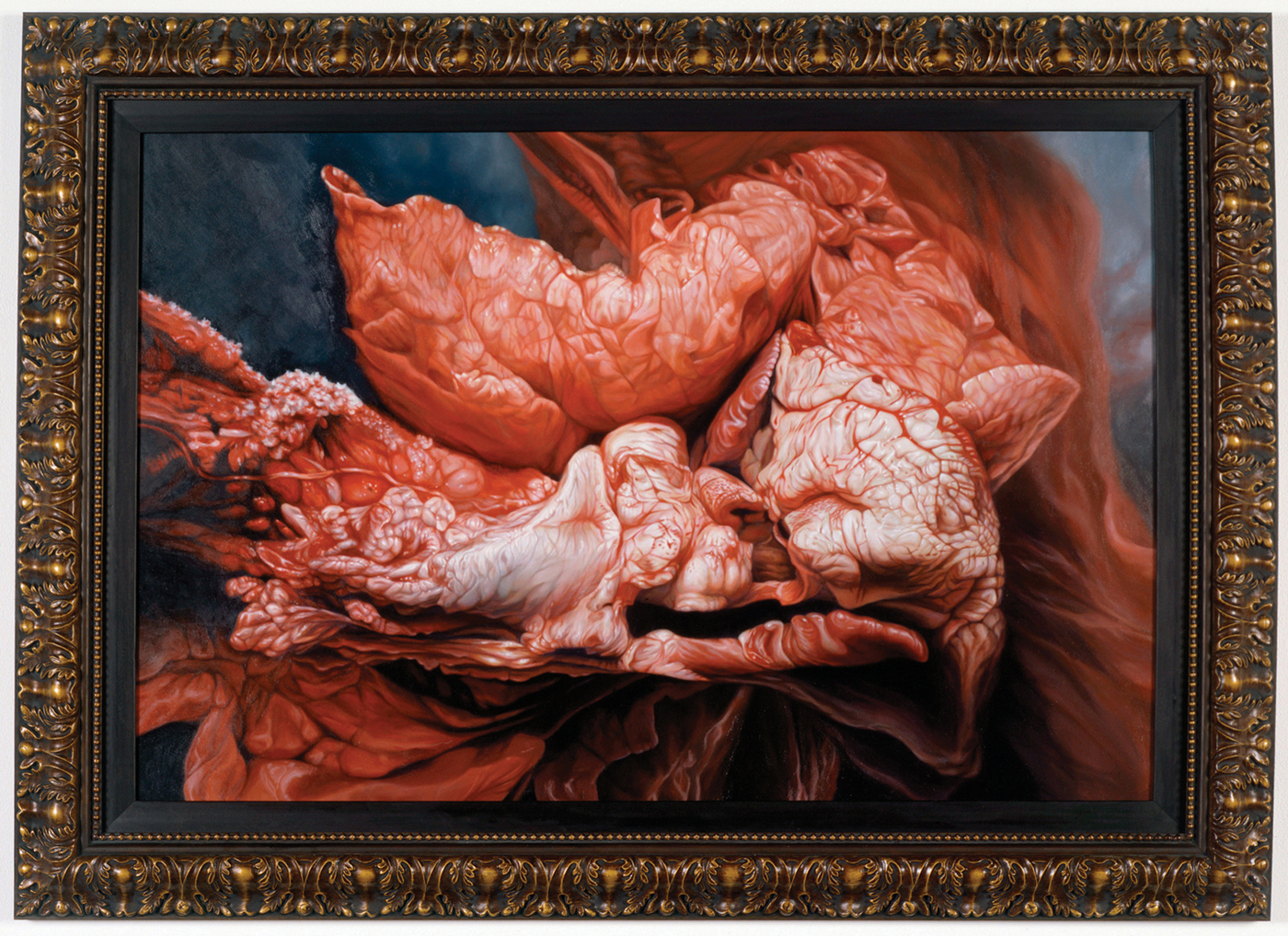
Despite this they are seemingly therapeutic and peaceful as an isolated image of flesh. the meat stops being meat and becomes a concurrently natural biological mass. This initially repulsive subject changes after the thought of shock they draw the viewer in for a closer inspection of its meticulously painted details and thoroughly intricate subject. In some of her later works the frames are less grand as she works on the piece itself being the pure interest of the piece.
Flight of the reindeer is one of her earlier pieces and has an incredible sense of depth to it as well as a level of detail unlike Soutine’s work this gives the viewer a clear image of what it is but not allowing them to understand what the entire piece is of. There is an air of mystery around the subject matter. The meat is meticulously clean unlike previous works the gore is present but unique in its manner that it should be rough and raw yet it looks washed. I feel this piece has a slight homage to Soutine as there is an uncannily similar blue draped background with a flipped parabola through the painting almost as if it is a section of hanging carcass. There is also a lack of bone or solid structure which should make the subject flaccid sagging but it appears rigid and taught in an apparently random composition. In the centre and the bottom of the piece the stark black shadows create and incredible sense of depth and contrast in these interspaced cracks trenches between muscles and organs In the cluster of gore.

Fat of the lamb is one of Reynolds’ game changing works where she began to move onto not just limiting her pieces to the canvas, rather she would incorporate her works into the Rocco Frame work creating a discretion between where the painting finished. The elaborate frames became a trend in her work through the last decade until her latest exhibition where she kept a lesser style of Rocco black Ripple frames which is used on the last work Uteral Bonnet. This piece uses a different more unusual palette of red, with a more Alizarin or Crimson colour. This immediately why I was attracted to it as this is very unusual and has a sense of disturbance about with this off colour. To me this protrudes a sense of decay and rot as if the flesh is decomposing and before our very eyes with cessation prominent. It is almost as if the frame encloses it like a tomb for its demise.
The detail she has used in the nobbles of fat protruding at the bottom put my heckles on end and as my eyes are brought across the painting my mind begins to envisage tangible parts of a body or figure as if it is twisting in my mind. This level of intricacy in such a rudimentary concept confuses and tricks the brain when approaching this painting as you just can wrap your mind to fully comprehend what the image is trying to put across except this underlying horror. This painting with its Rocco frame almost gives of a haunting gothic appearance that adds to the element of fear and initial unnerve.
Uteral Bonnet is one of Victoria Reynolds more recent pieces and straight away you can see that she has changed her frame style back to Black ripple Rocco which she used to use in her initial works. There is how ever a very disturbing and ominous feeling that hits the viewer straight away. The seemingly Vanta black background keeps this image motionless and lifeless focusing you on the only subject in the painting the ring of innards in the centre. The flesh reveals the shape of a head in the negative space it forms. This truly haunting image, as the name would suggest, gives connotations that it is almost a bonnet for a baby made from flesh.
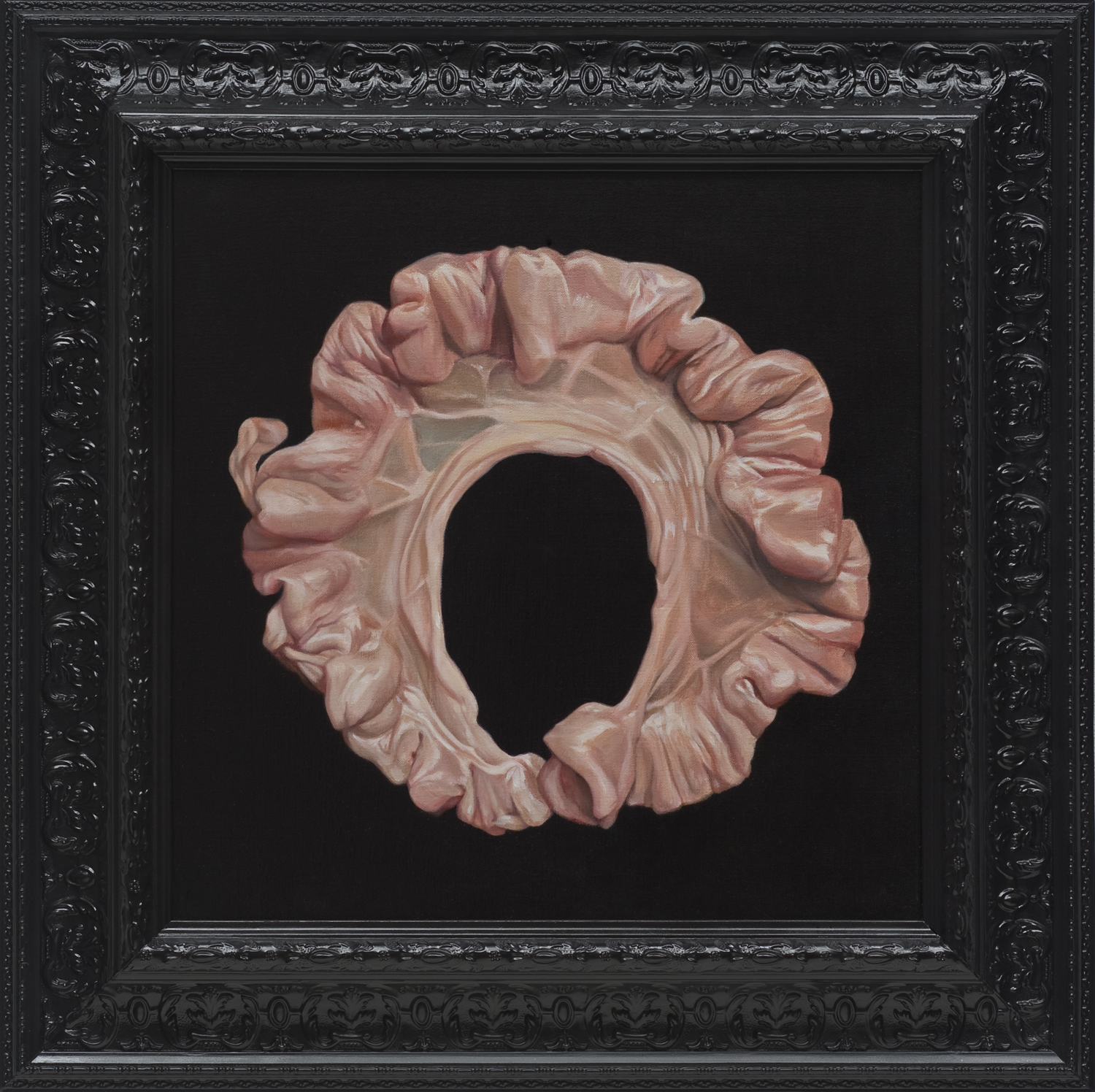
The light pink flesh looks fragile and soft with a pinching effect around the outside to gives the impression that it being intestinal gore and if the name does relate to the piece possibly the Uterus. Now this implication could carry a number of meanings but what It suggests to me with the dark theme and unnatural creepy overruling air about it seems to have a deathly serious note. With the combination of the name and the piece this evokes a horrible feeling of death perhaps even representing miscarriage of a child or a still born. The delicacy of topic like this seems matched with fragility of the this flesh the opaque tender stretched areas forming the bonnet for an infants’ head combined with the darkness seem to give off a haunting feeling. This might be down to the fact that we don’t know we aren’t sure of the subject but the encapsulating black draws our minds in and allows it to wonder about trying to find an arbitrary meaning. But fundamentally the reason this painting is so distressing an creepy is the lack of understanding and knowing of what it truly is.
The Cosmetically Beautiful Way of Seeing Red
Jenny Saville
Jenny Saville worked closely with the figure and saw her fair share of gore after getting her scholarship to the university of Cincinnati she was taken on by a plastic surgeon to watch them perform surgery and operate. This led to a line of work such as Plan or Fulcrum with the physical distortion of the body and the manipulation of flesh through liposuction or surgery.

Torso 2 is an homage to Rembrandts Slaughter ox much like Soutine’s Carcass of beef. like her predecessors Jenny bought a large ox carcass in a slaughter house and spent several days painting it from life. its approximately 3.5 meters by 3 meters which is relatively small for her work this was to allow her to paint the Ox without too much change from rot and the prevalent smell when she painted it. Nonetheless the reason I find this work so intriguing is the way she has used a greenish turquoise background with highlights of white; giving a cold background that one can really feel a slate like coolness of a slaughterhouse of fridge. However, there are these bright warm reds breaking through in just a slither of the painting where the Ox was gutted and decapitated. The range of softer flesh like pinks merging into powerful alizarins and even dark scarlets between the oesophagus. On the floor around the carcass a rich visceral syrup of sienna and crimson where the blood has run from the carcass and spread over the floor with an eerie shine. Despite the brutish bold brush strokes Jenny uses there are some amazing subtleties of flesh allowing the viewer an odd sense of tranquillity rather than a sense of death or disgust it is an appeasing piece.

Red Stare V is my favourite painting by Jenny Saville for a variety of reasons. The reason I have picked this stage of Red stare is because the deconstructed feel allows for a more basic understanding of the painting with a distinct gore of the face looking bloodied and the ‘skin’ looking raw whilst still keeping the crystal-clear eyes. Red stare was painted as a multiple of paintings all left at different stages and some done on different bases such as board and using different means of spreading the paint. This manner of freedom between each painting really attracted me to them as it allows uniqueness between a group of effectively the same paintings. The fragility of this painting is reinforced by the stark reds dispersed over the face with the violet manner of the brush strokes creating a contrast of opaque strokes and a solid block of colour in the cheeks, allowing for a perception of depth but not of ‘wholeness’ and fractured features of the boy combined with the vacant gaze send shivers down my spine. The way she has painted the eyes almost makes them feel like they have an alternate medium. The high contrast of the photo realistic glassy bloodshot eyes with the sketchy looseness of the face progressing up the head to the back of the head which is why I like this painting so much.
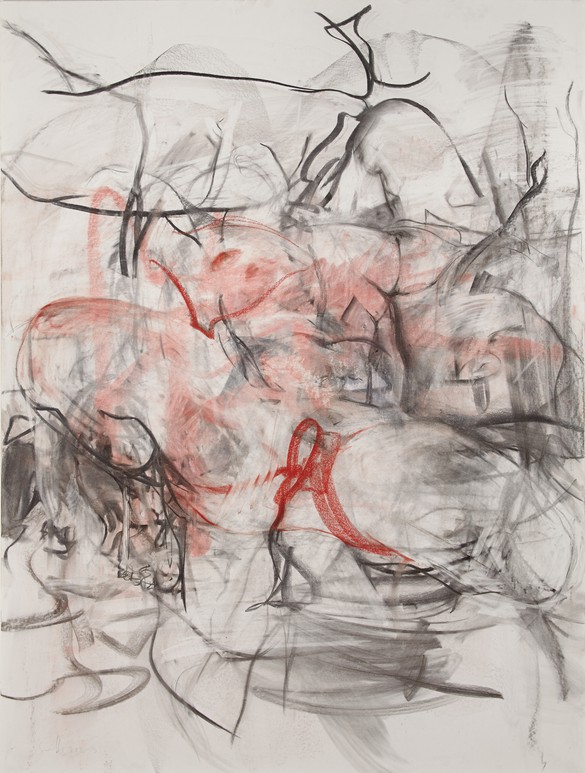
Reflective Flesh study (Red) is one of Jenny Saville’s later works and she has said herself they are less complex in the manner they are created as they don’t require as much time as oil paints but in the outcome, they are a far more intricate piece rife with meaning and connotations. She has put this down to being a full-time mother and feels she has changed her perspective on life and she now has a grittier view of life ‘I like the down and dirty side of things, its only natural’ – jenny Saville. The piece has a vagueness about it allowing the viewer to see what they want within the lines and marks creating your own perception of it. The simple black and red work very effectively with each other denoting different plains of delimitation creating an amalgamation of bodies and movement as well as the vibrant red having a more raw sexual connotation highlighting chest and groin whilst the black delineates more movement of limbs and perhaps a head or even one of her children. The simplification of colour in this piece helps to show how alluring and eye catching red truly is and why it has been a fundamental part of the colour palette and has been such a prized pigment all of history.
 Harry Toller